BA Honours Film (2019), Bournemouth University | Master of Letters Film Studies (2020), University of St Andrews | frieda.gerhardt@plymouth.ac.uk
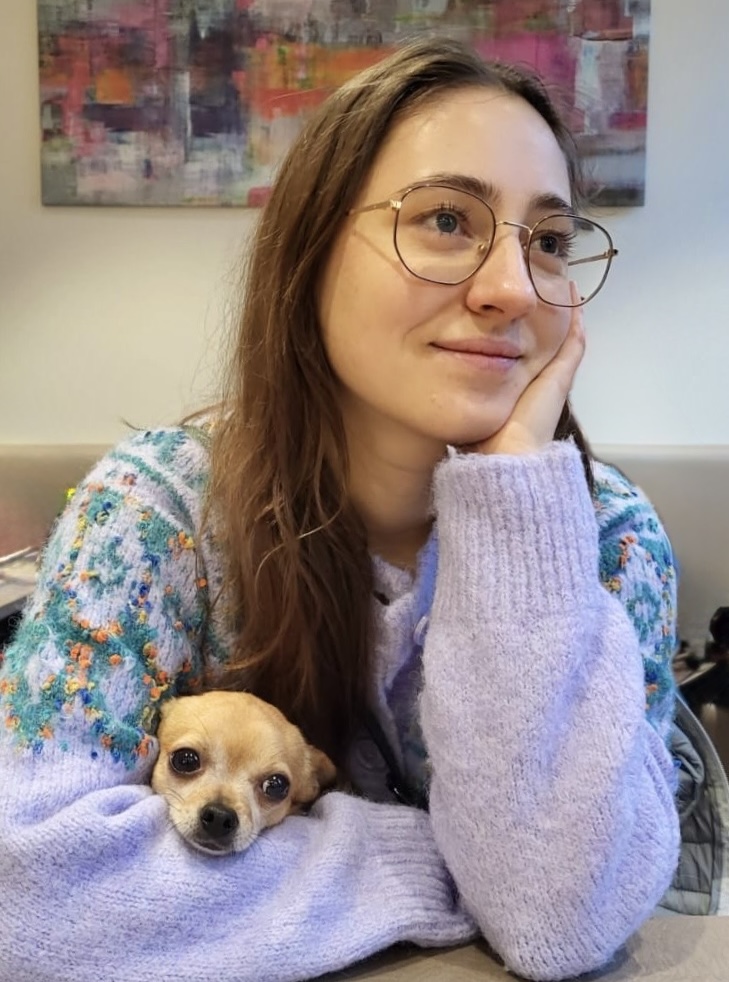
Frieda “Free” Gerhardt (she/her/they/them)
I am a visual artist, certified as a graphic designer in my home country of Germany. I relocated to the UK to study film and specialised, among other things, in camera & lighting and documentary film practice. I used this to explore alternative ways of treating “non-normative” perceptions and lived experiences (specifically, sensory processing sensitivity). Subsequently, I completed an MLitt at the University of St Andrews, with a dissertation concerning the sensory aspects of the first experiments in natural science film and early (German) film theory. Besides my ongoing occasional role as a freelance graphic designer, photo- and videographer, I spent the next five years also working as a tutor and completed a certificate in integrative learning therapy, specialising particularly on learning disabilities. This led to research into neurodiversity, perception and neuro- and cognitive science, through certificates in philosophy of science.
Since 2023, I have been reading for a PhD in art, technology, & health with Transtechnology Research at the University of Plymouth. This research foregrounds my lived experience and practical background as a queer, neurodiverse filmmaker, shaping responses to film theory and healthcare.
My doctoral thesis addresses the question of how an embodied, sensory understanding of the “act of filming” might be valuable as a methodological intervention into film theory and practice to further a “neurodiverse” approach to filmmaking. For this research, I am in close collaboration with a major UK hospital in a project that deals with a variety of simulation practices with the aim of bettering human skills in healthcare training. Images resulting from my own practice have been tested to have a calming and trance-evoking effect, which mirrors the experience I have while capturing them. The findings of this work inform my most recent paper (to be presented at the British Academy of Film, Television and Screen Studies in April), which extends the idea of the camera as a tool whose presence is “necessary to materialise a way of thinking, of situating oneself”, as suggested by poet and ethologist Fernand Deligny in his practice of camering. It asserts that focusing on film as a process, rather than a product, affords an unfolding of the sensorily rich “act of filming” as a method to subvert the constrictions of the cinematic apparatus.